Five local AI models this week: Flint and Nemotron Bolt E4B
October 27, 2026
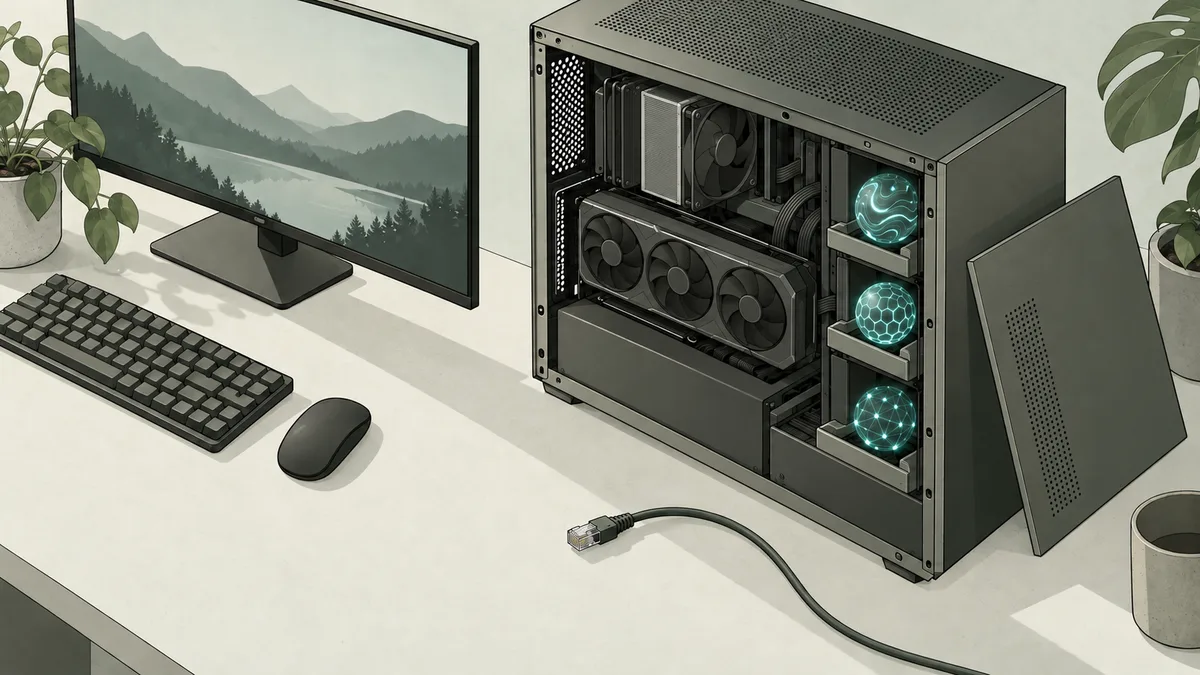
A local AI model is one you download to your own computer and run without an internet connection. Five arrived this week (Oct 20 to 27): Flint, a coding model; Nemotron 3.5 Bolt E4B, a small model from NVIDIA; Raon-1 mini preview, a Korean-language model from KRAFTON; Nanbeige4.3-33B; and a large one, Ornith-1.5-122B. Of the five, Flint has the most likes on Hugging Face (a site where AI models are posted and downloaded).
This series looks at everything through one reference machine: a Windows PC with 8GB of graphics card memory and 64GB of system memory. Performance numbers are passed along exactly as each company published them. Whether a model fits that PC is judged from the real file size. Test setups differ from company to company, so scores from different models are not compared with each other.
A model card is the description page a maker posts on Hugging Face. Below, "the card says" means what that page says.
| Model | Maker | License |
|---|---|---|
| Flint | Recursive | Apache 2.0 |
| Bolt E4B | NVIDIA | OpenMDW-1.1 |
| Raon-1 mini | KRAFTON | Apache 2.0 |
| Nanbeige4.3 | Nanbeige | Apache 2.0 |
| Ornith-1.5 | Ornith AI | MIT |
| Model | Strengths |
|---|---|
| Flint | Coding, tool use |
| Bolt E4B | Small file, tool use, chat |
| Raon-1 mini | Korean, reasoning |
| Nanbeige4.3 | Coding, tool use, reasoning |
| Ornith-1.5 | Coding, tool use, reasoning |
The strength tags on the Local AI page are assigned by rule from Ollama's labels and descriptions, so they differ from this table in places.
Flint
Strengths: coding, tool use
Recursive released this coding model on Oct 21. It has 39.8B (39.8 billion) parameters in total, the number that describes a model's size, but only about 2.5B of them (the active parameters) are used to produce each token (a small piece of text). It is a mixture-of-experts (MoE) design, so the total size is big while the part used at any one moment is small. The model card says it was built to explore a codebase, fix bugs, build features, and write tests, and that it supports working by calling tools many times in a row. The card gives its context length (how much text it can hold in mind at once) as 262,144 tokens.
The license is Apache 2.0, an open-source license that broadly allows modification and redistribution. The original text allows copying, distribution, and making derivative works free of charge, and has no sentence limiting what the model can be used for. Anyone redistributing it has to keep a copy of the license and the notices. The card also says that the terms and data practices for the hosted API are separate from the license on the model files.
The published scores are 54.9% on Terminal-Bench 2.1, 74.2% on SWE-bench Verified, and 89.7% on SWE-bench Pro v2. SWE-bench measures how many real problems from software repositories a model can fix, and Terminal-Bench measures how many tasks it can finish in a terminal (a screen where you type commands). A higher score means more solved. All of them come from Recursive's own evaluation, and the card notes that scores can change with the evaluation settings and the environment it runs in. When scoring Terminal-Bench, Recursive counted solutions fetched from the internet as failures, and the card adds that other companies' scores may not have had the same adjustment.
The original files in the Hugging Face repo RecursiveSI/flint come to about 80GB, and the run instructions assume one data-center graphics card. For a home PC, the converted GGUF files are the way in. In unsloth/flint-GGUF, the smallest file is 11.35GB, but that is a version with quality cut sharply (IQ1_M), and Q4_K_XL is 25.05GB. In these file names, a smaller number after the Q means a smaller file and lower quality. On Ollama (a program that runs AI models on your own computer), ollama run flint downloads a 23GB file, and on Windows it runs from version 0.40.9.
Bottom line: on Windows with Ollama 0.40.9 or later, one command downloads it. At 23GB, though, it is not a size that fits entirely on a single 8GB graphics card.
Nemotron 3.5 Bolt E4B
Strengths: small file, tool use, chat and writing
NVIDIA took Google's Gemma 4 E4B and trained it further to make this small model. Ollama added it to its library on Oct 23, in version 0.40.10. The card says it targets places that need quick answers with little memory, such as devices and voice assistants. It lists support for conversations that call tools many times in a row, and a chat mode that gives short answers that sound natural spoken aloud.
The license is OpenMDW-1.1, and the Gemma 4 it builds on is Apache 2.0. The card says it can be used commercially and non-commercially. The grant in the original text lets anyone use the model materials free of charge, without restriction. Anyone redistributing it has to keep a copy of the agreement and the copyright notice, and filing a patent or copyright lawsuit ends the rights.
The scores on the card are 68.5 on BFCL-v3, 63.8 on IFBench, and 55.1 on Tau2-Bench. BFCL checks whether a model picks the right tool and fills in its values correctly, IFBench checks whether it follows instructions precisely, and Tau2-Bench checks how well it handles tasks that involve talking with a user over several turns while using tools. In the card's comparison table, other models come out ahead on some tests, so Bolt does not win every category.
Small here means file size. The converted file NVIDIA posted on Hugging Face under a name ending in -4GB is actually 6.18GB. On Ollama, ollama run nemotron-3.5-bolt:e4b downloads 7.9GB in total: 6.2GB for the model itself, plus the part that handles images and other pieces. Leave off :e4b and you get a 25GB file instead, so the tag is required.
Bottom line: of this week's models, this one has the file size closest to an 8GB graphics card.
Raon-1 mini preview
Strengths: Korean, reasoning
KRAFTON AI released it on Oct 21, and the card says it was designed and trained from scratch. It is an MoE with 28.8B parameters in total and 4.3B used at once. Korean is one of its 7 supported languages, and the card says it is strong at Korean conversation. It is a preview, so the card says specifications and results may change before the final version.
The license is Apache 2.0. The Hugging Face repo does require an access request, though, and approval is automatic. Its Korean conversation score, Chatbot Korean 92.9, comes from an internal KRAFTON evaluation, so nobody outside can rerun it. The card also lists GPQA Diamond 84.3 and AIME 2026 93.3. GPQA Diamond is a set of graduate-level science questions, and AIME is a high school math competition.
The converted files are 16.07GB for IQ4_XS and 19.69GB for Q4_K_M. The card's llama.cpp (one of the programs that run models) instructions have you download a modified copy KRAFTON published separately and build it yourself.
Nanbeige4.3-33B
Strengths: coding, tool use, reasoning
A 33B model from Nanbeige LLM Lab, posted to Hugging Face on Oct 24. The license is Apache 2.0, and the maximum context length is 524,288 tokens. The card puts agentic coding front and center and calls it the best among open models in the 30B class. Its own scores are Terminal-Bench 2.1 at 80.9, Toolathlon-Verified at 70.4, GPQA Diamond at 89.5, and AIME 2026 at 95.2. In the same card's table, comparison models score higher on three tests: SWE-Bench Pro, GDPval, and GPQA Diamond.
The original files are about 66.2GB. The community-made conversion mradermacher/Nanbeige4.3-33B-GGUF is 12.66GB at Q2_K and 20.05GB at Q4_K_M. These are not conversions published by the developer.
Ornith-1.5-122B
Strengths: coding, tool use, reasoning
A 122B mixture-of-experts model from Ornith AI, added to Ollama's library this week. The license is MIT, an open-source license that allows copying and distribution and asks only that the notices be kept. The card says it is optimized for terminal coding agents, produces the function calls used for tool use correctly, and is a reasoning model that thinks inside a <think> block before answering. The scores are TerminalBench 2.1 at 81.2 and SWE-bench Verified at 84.5. Ollama's ornith-1.5:122b is between 73GB and 77GB, larger even than the 72GB you get by adding 8GB of graphics card memory to 64GB of system memory.
What stood out this week
First, two MoE models, each big overall but small in what it uses at once, came out on the same day. Flint and Raon were both released on Oct 21. Support arrived at different speeds. Flint's support was merged into llama.cpp the same day, and Ollama added it in 0.40.8 for Mac and 0.40.9 for Linux and Windows. Raon's instructions have you download a modified copy of llama.cpp from KRAFTON and build it yourself.
Second, Ollama shipped four new versions this week. From 0.40.8 to 0.40.11, it added Flint and Bolt in turn, and 0.40.11, on Oct 24, added speech generation on Mac. On Windows, Flint needs Ollama 0.40.9 or later and Bolt needs 0.40.10 or later.
Trying it out
Here is the order of steps for running Nemotron Bolt E4B with Ollama.
- Download the Windows installer from ollama.com and install it. Administrator rights aren't needed. Windows 10 22H2 or later is required, and an NVIDIA graphics card needs driver 551.61 or later. Bolt downloads on Ollama 0.40.10 or later.
- In a terminal (on Windows, search for "Terminal" or "Command Prompt" in the Start menu), enter
ollama run nemotron-3.5-bolt:e4b. It downloads 7.9GB, then the chat starts right away. - To quit, enter
/bye. Flint, the model with the most likes on Hugging Face, works the same way withollama run flint.
When graphics card memory is under 24GB, Ollama sets the default context length to 4K tokens. For coding tools it recommends 64,000 tokens or more, and a longer context needs more memory. Change it with the slider in the app or with the environment variable OLLAMA_CONTEXT_LENGTH.
On an 8GB graphics card
Here are this week's file sizes next to the reference machine.
| Model and file | Size |
|---|---|
| Bolt, Hugging Face conversion | 6.18GB |
| Bolt, Ollama e4b | 7.9GB |
| Flint, smallest conversion | 11.35GB |
| Nanbeige, Q2_K conversion | 12.66GB |
| Raon, IQ4_XS conversion | 16.07GB |
| Nanbeige, Q4_K_M conversion | 20.05GB |
| Flint, Ollama | 23GB |
| Ornith, Ollama | 73 to 77GB |
Two files are under 8GB: Bolt's Hugging Face conversion (6.18GB) and the Ollama version (7.9GB). At 7.9GB, the Ollama version is only 0.1GB under 8GB, so there is almost no room to spare. Everything else is over 8GB, and Ornith is the only file larger than the 64GB of system memory.
A model that doesn't fit entirely on the graphics card spills part of itself into system memory. The PROCESSOR column in ollama ps shows how much spilled over. 100% GPU means it all sits on the graphics card, and 48%/52% CPU/GPU means it is split between system memory and the graphics card.
To filter every model covered so far by strength and compare file sizes at a glance, see Local AI.
Sources (checked Oct 27, 2026)
- Flint, Hugging Face card
- Flint conversions, unsloth
- Flint, Ollama library
- PR 30928, adding Flint support to llama.cpp
- Nemotron 3.5 Bolt E4B BF16 card, NVIDIA
- Nemotron 3.5 Bolt E4B 4GB conversion, NVIDIA
- Nemotron 3.5 Bolt, Ollama tag list
- OpenMDW-1.1 license text
- Raon-1 mini preview, Hugging Face card
- Raon-1 mini preview conversions
- Nanbeige4.3-33B, Hugging Face card
- Nanbeige4.3-33B conversions, mradermacher
- Ornith-1.5-122B, Hugging Face card
- Ornith-1.5, Ollama library
- Ollama 0.40.8 release
- Ollama 0.40.9 release
- Ollama 0.40.10 release
- Ollama 0.40.11 release
- Ollama Windows docs
- Ollama context length docs
- Ollama FAQ