How many days left: and why the count is off by one
From March 1 to March 10 is nine days. It's also ten days.
Both are right. What hasn't been decided is whether today counts.
Countdowns, hundred-day anniversaries and ages all count by different rules.
Which one is a countdown
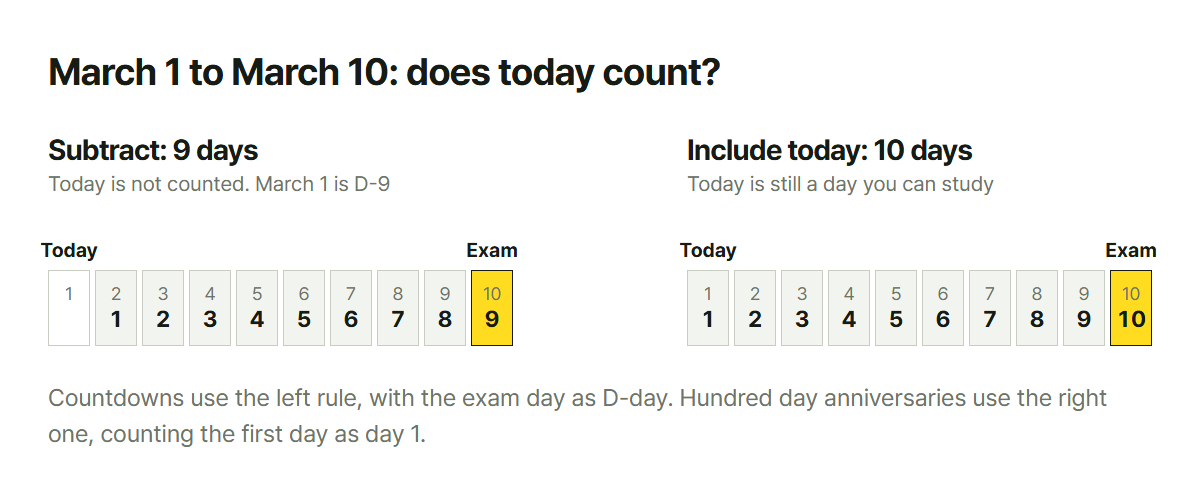
The exam is on March 10 and today is March 1. How many days left?
- Subtract and you get 9
- Include today and you get 10
For revision, today is still a day you can study, so 10. For "how long until it arrives", 9. Both are correct, they just answer different questions.
Counting down to something, you would normally use the first.
Counting the other way
Anniversaries split here. Counting to a hundred days together, the day you met is day 1, so the hundredth day is 99 days after you met.
Birthdays are the opposite. The day you're born you're 0, and your first birthday is a year later.
Either rule is simple on its own. Mistakes come from starting to count before deciding which rule is in play.
Months are different lengths
31 days: Jan, Mar, May, Jul, Aug, Oct, Dec
30 days: Apr, Jun, Sep, Nov
28 days: Feb (29 in a leap year)
The fastest way is your knuckles: make a fist and count across the bumps and dips. A bump is 31, a dip is 30. When you reach July on a bump, switch hands and August is a bump too.
Leap years divide by 4, except centuries, which do not, unless they divide by 400. 2000 was a leap year; 1900 was not.
Why "in two weeks" rarely goes wrong
Counting in weeks is safe because seven days later is always the same weekday. If today is Tuesday, two weeks from now is Tuesday, even across a month boundary.
So for scheduling, "Tuesday in two weeks" is misread less often than "March 25". In a document, write both.
Business days are their own thing
"Five business days" excludes weekends and public holidays. Start on a Monday and you land on the following Monday, and if a holiday falls in the middle, Tuesday.
You'll meet this wording in government paperwork, deliveries and refunds. Counting five days on a calendar is wrong almost every time.
What this does not cover
- Korean public holidays: Seollal and Chuseok follow the lunar calendar, so their dates move every
year, and substitute holidays have their own rules
- The legal definition of age
- Working days and leave entitlement: every company has its own rules
Clicking a date on the calendar gives you its distance from today. Future dates count down, past dates count up.
Months page back and forward, which covers the "third Thursday of next month" sort of question. Weekday names and the first day of the week follow whatever display language you're in.
A date you cannot afford to forget deserves more than a count. The schedule box keeps it, dots that day on the calendar, and reminds you at the hour if you add one.