Six ways to get paid from an app
August 25, 2026
* As of August 2026. Rates change often, so check with each provider before you commit.
Six ways
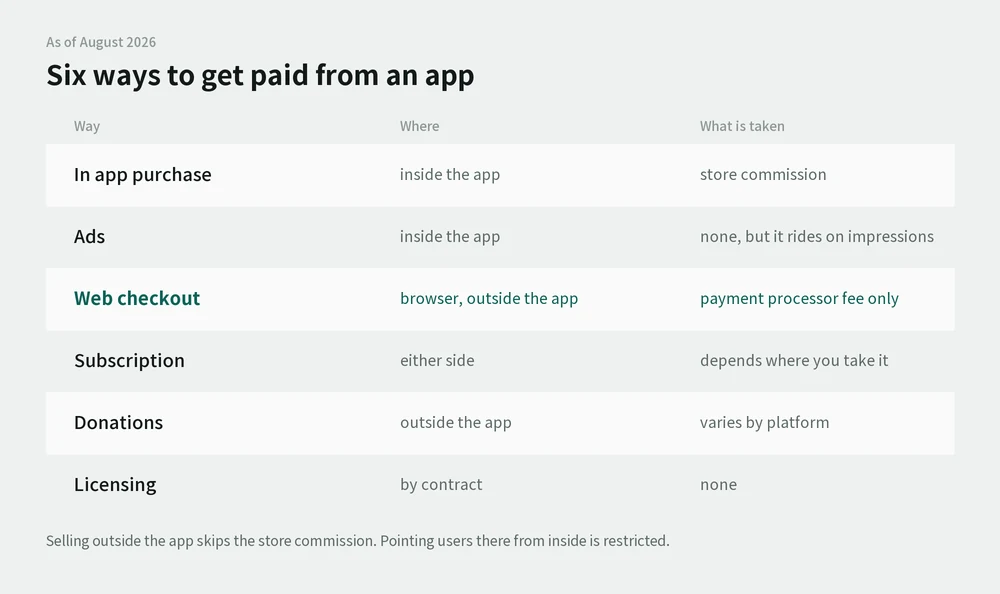
| Way | Where the money changes hands | What gets deducted |
|---|---|---|
| In-app purchase | Inside the app | Store commission |
| Ads | Inside the app | Nothing, but revenue tracks impressions |
| Web checkout | In a browser, outside the app | Payment processor fee only |
| Subscription | Either side | Depends where it is taken |
| Donations | Outside the app | Varies by platform |
| Licensing | By contract | Nothing |
In-app purchase
Paying inside the app routes through the store. Google and Apple both take a commission. Both run programs that lower the rate for developers under a revenue threshold.
- Blocker: policy generally requires digital goods to use in-app purchase. Physical goods are the exception
- Needs checking: rates and exceptions differ by country and change over time
Ads
Banner or rewarded ads. These can be wired up with sample IDs before an ad account exists.
- Blocker: apps aimed at children face much stricter ad rules
- Blocker: revenue tracks impressions, so a small audience earns close to nothing
Web checkout
Selling outside the app skips the store commission. The purchase happens in a browser and the app only reads the result. Stripe and similar processors handle this.
- Deducted: only the processor fee, well below a store commission
- Blocker: telling users inside the app to buy elsewhere is restricted by store policy. What is allowed differs by country and has been changing, so this one needs checking
Subscription
Recurring instead of one-time. Revenue becomes predictable, but there has to be something new to deliver.
- Blocker: if there's nothing new each month, cancellation comes fast
- Blocker: subscribing inside the store carries the same commission structure as in-app purchase
Donations
It's free to use, with a way to pay for anyone who wants to. GitHub Sponsors and the buy-me-a-coffee services sit here.
- Blocker: amounts are unpredictable, and it rarely covers running costs on its own
Licensing
Selling the tool to a company. Nothing takes a cut and the deals are larger.
- Blocker: it takes sales and contracts, which isn't the same kind of time as building
- Blocker: selling to companies brings security review and documentation requests
What's been verified
| Actually wired up | Ads, including sample IDs. The in-app purchase placeholder |
| Conditions checked only | Web checkout, subscription, donations, licensing |