Inches, pounds, cups: the units that differ by country
A cup is a unit you have to ask the nationality of first.
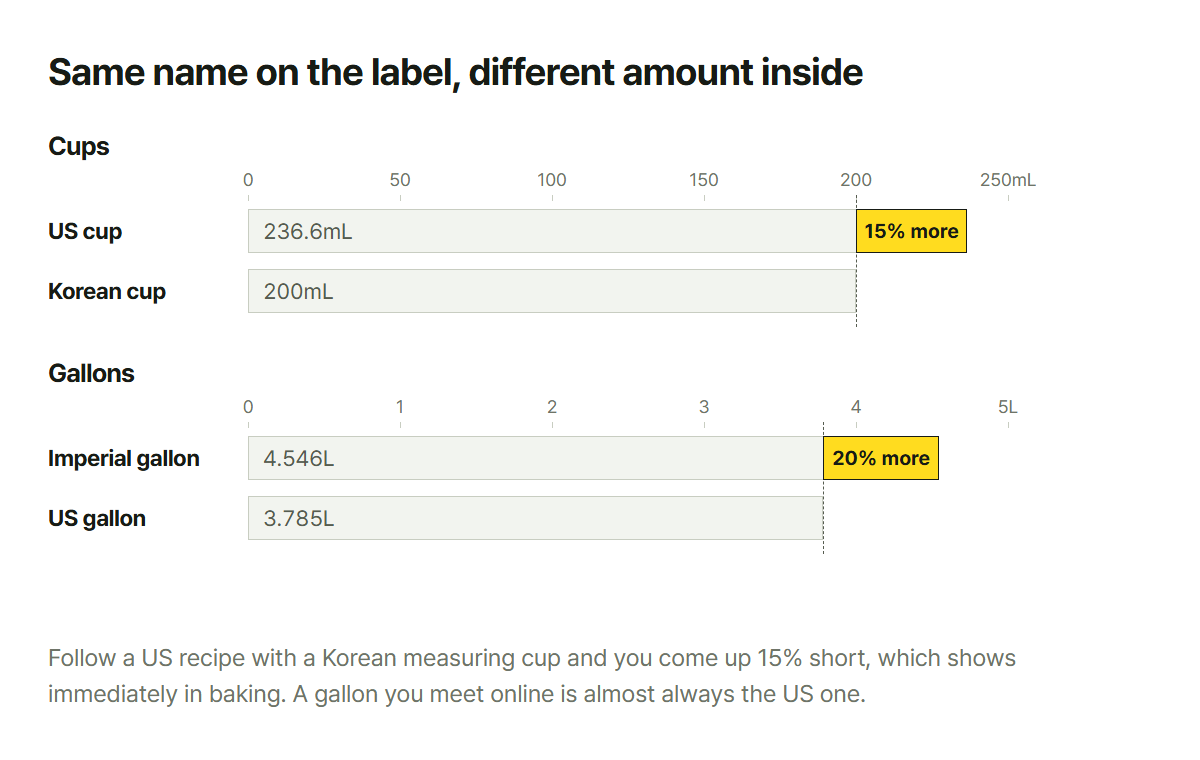
In a US recipe it is 236.6mL. In a Korean measuring cup it is 200mL. Same "one cup", 15% apart.
Some units are a single multiplication. Others split like this.
First, the ones that behave
| Unit | Value |
|---|---|
| 1 inch | 2.54cm (exactly) |
| 1 foot | 30.48cm (12 inches) |
| 1 yard | 91.44cm |
| 1 mile | about 1.609km |
| 1 pound | about 453.6g |
| 1 ounce | about 28.35g |
Inches are easy to estimate. Multiply by 2.5 and you land slightly under: 27 × 2.5 = 67.5, and a 27-inch monitor is really 68.6cm. Close enough to picture it.
Cups: where cooking goes wrong
If a recipe says "1 cup of flour", the first question is which country wrote it.
| Volume | |
|---|---|
| US cup | 236.6mL |
| Korean cup | 200mL |
| Metric cup (Australia, NZ, Canada) | 250mL |
| Japanese cup | 200mL |
Follow a US recipe with a Korean measuring cup and you're 15% short. In a soup or a stir-fry nobody notices. In bread and cakes it shows immediately: get the flour-to-liquid ratio wrong and the dough won't come together; get the baking powder wrong and it won't rise.
Most recipes circulating online are American originals in translation. If you see "cup", it's probably 236.6mL. To be certain, find a recipe written in grams.
Tablespoons and teaspoons differ too, but barely (US tablespoon 14.8mL, Korean 15mL). Ignore that one.
Gallons: 20% apart
| Volume | |
|---|---|
| US gallon | 3.785L |
| Imperial gallon | 4.546L |
That is a 20% gap. Read American figures as imperial and your gas mileage math is wrong throughout: "30 miles per gallon" means different things depending on which gallon.
A gallon you meet online is almost always the US one. The UK uses litres in daily life.
Pints and fluid ounces have the same problem
A pint of beer is 473mL in the US and 568mL in the UK: nearly 100mL apart. Order a pint in a British pub and you visibly get more.
Pyeong: a Korean one worth knowing
One pyeong (평) is about 3.3058m², and 1m² is about 0.3025 pyeong.
Korean property listings switched to m² long ago, but people still talk in pyeong. For estimating, m² ÷ 3.3 or pyeong × 3.3 is plenty: 84m² is 25.4 pyeong, 59m² is 17.8.
One caution that is not really about units: the "34 pyeong" in a listing is usually the supply area, and the space you actually live in is smaller. That is a question of what is being measured, not of conversion.
Temperature is not a multiplication
Fahrenheit starts from a different zero, so multiplying alone does not work.
C = (F − 32) × 5 ÷ 9
F = C × 9 ÷ 5 + 32
To estimate in your head, subtract 30 and halve it. 70°F becomes (70−30)÷2 = 20°C. The real answer is 21.1°C, which is close enough to know how to dress.
Two worth remembering: 32°F is 0°C (freezing), and 98.6°F is 37°C (body temperature). 100°F is 37.8°C, which is already a mild fever.
What this does not cover
- Converting volume to weight: "how many grams is a cup of flour" depends on the ingredient.
Flour and sugar do not weigh the same at the same volume
- Clothing and shoe sizes: those are national sizing standards, not units
- The 1000 vs 1024 problem in data sizes: drive manufacturers and operating systems count
differently
Length, area, weight, volume, speed, temperature and data sit in one box.
Units that split by country carry the country in the name: cup (US), cup (KR, 200mL), gallon (US), gallon (UK). That labeling is deliberate. A tool that just says "cup" is how you end up 15% short, so check the label before trusting a recipe conversion.
Korean units stayed in the English list as well: pyeong for apartment listings, geun at the butcher, don for gold. Anyone working here runs into those sooner rather than later.